



Every business that runs on more than one system eventually gets the message. The sync is down again. An order did not make it from the store into the accounting system, or the stock levels in two places no longer agree, or a customer record updated everywhere except the one place it mattered. Someone re-keys the data by hand to unblock the day, an engineer patches the connection, everyone moves on, and a few weeks later the same thing breaks in a slightly different way. If that cycle feels familiar, the problem is almost never the specific bug that broke this time. It is the way the integration was built in the first place.
Fragile integrations are a design problem wearing the costume of a coding problem. The individual failures look like bad luck, an API that changed without warning, a field that was renamed, a format that shifted. But the reason a small change on one side can bring the whole thing down is structural, and until you fix the structure you are just waiting for the next break.
Point-to-point is the trap
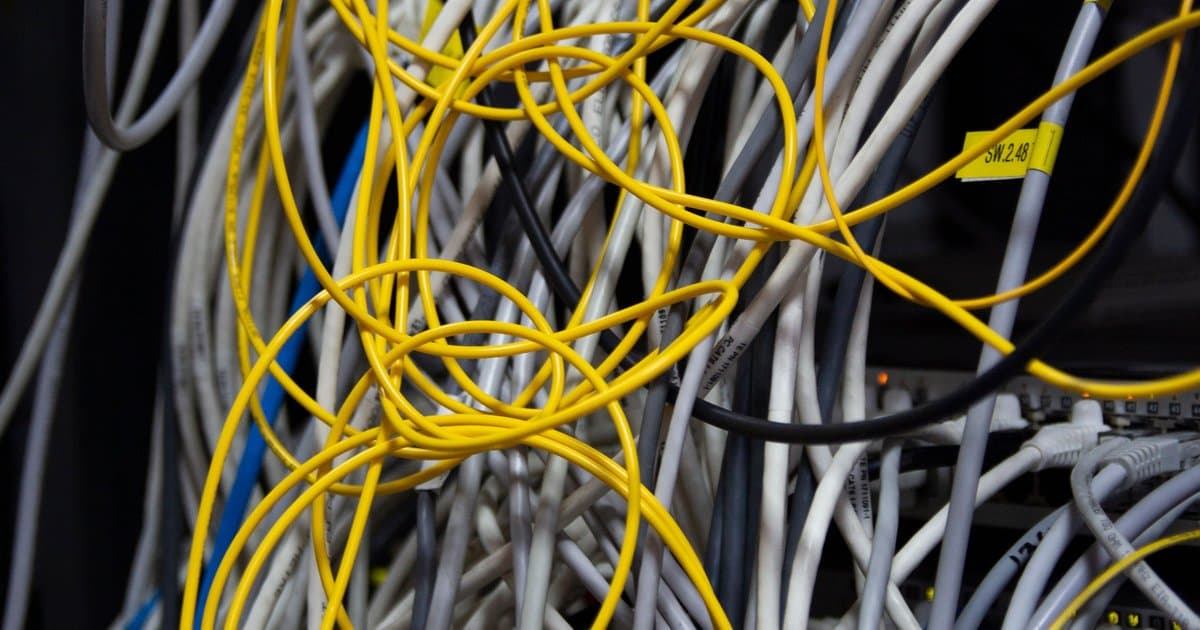
The most common way integrations get built is the most intuitive one. You have System A and System B, and you need them to talk, so you write a direct connection between them. Then System C arrives and needs data from A and B, so you add two more connections. Then B and C need to sync too. Before long you have a spider's web of direct wires, each one coded to the specific quirks of the two systems it joins, and each one a separate thing that can break.
The trouble with this shape is that every connection carries a set of hidden assumptions about how the other system behaves. It assumes a field is always present, that a date looks a certain way, that a response comes back in a particular structure. Those assumptions are invisible and undocumented, and they are true right up until the day a vendor ships an update or someone reconfigures a system. Then the assumption is quietly false, the wire snaps, and because nothing else was designed to catch it, the failure flows straight through. The more systems you connect this way, the more wires you have, and the number of things that can break grows faster than the number of systems you added.
Integrations fail silently, which is worse
There is a second problem that makes the first one far more expensive. Most point-to-point integrations have no monitoring. They run quietly in the background, and when they work nobody thinks about them. So when one fails, nobody is told. The sync just stops, or starts skipping records, and the first sign of trouble is a human noticing that two numbers do not match, or a customer asking where their order is, often weeks later.
By then the damage has compounded. Every day the broken integration ran, it either moved nothing or moved something wrong, and that bad or missing data has spread into reports, into other systems, into decisions. A failure you catch in the first minute is a small fix. The same failure caught a month later is a data cleanup project. Silence is the difference between the two, and silence is the default when integrations are built as fire-and-forget wires with no one watching them.
Nobody owns the integration
Ask who owns the connection between your store and your accounting system and you often get a pause. The person who originally built it has moved on, or it was a vendor project that ended at go-live, or it lives in a script somewhere that only one busy engineer half-remembers. An integration with no owner does not get maintained, monitored, or updated as the systems on either end evolve. It just sits there quietly accumulating risk until it breaks, at which point there is a scramble to work out how it was even supposed to function.
This is the same failure mode that quietly undermines a lot of software, and it is worth naming plainly. An integration is not a one-time wiring job that is finished when the data first flows. It is a living connection between two systems that both keep changing, which means it needs an owner and a maintenance posture for as long as it runs.
What a durable integration layer looks like
The fix is to stop wiring systems directly to each other and put a layer in between. Instead of A talking straight to B, both talk to an integration layer that sits in the middle and does the unglamorous work in one place: mapping fields between systems, validating that data is well-formed before it moves, retrying when a call fails, and raising a clear alert when something is genuinely wrong. Systems connect to the layer, not to each other.
That single change fixes the structural problem. When a vendor updates their API, you adjust one place in the layer instead of hunting through a dozen direct connections. When a record is malformed, the layer catches it and tells someone rather than passing the mess downstream. When a sync fails, it fails loudly, with a log of what happened and an alert to a named person, so it is a five-minute fix rather than a month-long cleanup. The layer costs a little more to build than a quick direct wire, but it converts many fragile, silent, unowned connections into one maintained surface that is designed to bend when a system changes instead of snapping.
A worked example
A retailer came to us because their online store and their accounting and inventory systems kept falling out of sync. Orders sometimes did not appear in accounts, stock counts drifted apart, and every few weeks someone spent a day reconciling by hand and re-entering what had been lost. Each time, an engineer had patched the specific break. Nobody had asked why the breaks kept coming.
The systems were joined by direct point-to-point scripts, each written to the exact shape of the data at the time it was built, none of them monitored. When the store platform pushed a routine update that changed a field, the scripts that depended on that field failed, silently, and kept failing until a human noticed the numbers were wrong. We did not add another patch. We put an integration layer between the systems that validated every record, retried transient failures, and alerted the operations lead the moment a sync went wrong, with a log of exactly what broke. The manual reconciliation stopped, because the data stopped drifting, and on the next platform update the layer flagged the change in minutes instead of letting it quietly corrupt a month of records.
Build it to bend, not to break
If your integrations keep breaking, the answer is not a better patch for this week's break. It is to look at the shape of how your systems are connected, because brittle, silent, unowned point-to-point wires will keep failing no matter how carefully each one is fixed. Build the connection to absorb change, watch it, and give it an owner, and the 2am sync-is-down message stops being a regular event.
Making disparate systems talk to each other reliably is exactly what our API and system integration work is built around: replacing fragile direct connections with a maintained layer that bends instead of breaking. Book a discovery call and we will look at where your systems are wired together and where that is quietly costing you.
Frequently asked questions
Why do my integrations keep breaking?
Usually because they are built as direct point-to-point connections held together by assumptions about how each system behaves. When one system changes an API, renames a field, or returns data in a slightly different shape, the assumption breaks and the integration snaps. Most integrations also have no monitoring and no owner, so they fail quietly and are only noticed when someone downstream spots wrong or missing data. The breakage is rarely a coding mistake. It is the predictable result of wiring systems together directly instead of through a layer built to absorb change.
What is the difference between a point-to-point integration and an integration layer?
A point-to-point integration is a direct wire from one system to another, coded to that specific pair. With a handful of systems you get a tangle of these wires, each one a separate thing to maintain and each one able to break the others. An integration layer sits in the middle: systems talk to it rather than directly to each other, and it handles the mapping, validation, retries, and error handling in one place. It costs a little more to set up, but it turns many fragile connections into one maintained surface, so a change in one system is absorbed in one place instead of rippling everywhere.
How do I stop integrations from failing silently?
Build in visibility from the start. Every integration should log what it sent and received, alert a named person when a sync fails or a record is rejected, and never swallow an error quietly. A failed sync that raises an alert is a minor issue; a failed sync that nobody sees becomes dirty data spreading through your systems for weeks before anyone notices. The goal is that the integration tells you it is unhealthy long before a customer or a report does.
Should we build integrations in-house or use a tool like Zapier?
For simple, low-volume, low-risk connections, an off-the-shelf tool is often the right call and not worth rebuilding. The case for a custom integration layer grows as the connections become business-critical, higher-volume, or complex, where you need proper error handling, retries, data validation, and monitoring that generic tools do not give you. The honest answer depends on what the integration carries: if it moves money, orders, or data your operation depends on, it deserves to be built and maintained like the critical infrastructure it is, not left as a fragile convenience.